 Ocean Flux
Canadian · ecology first
Restore the ocean’s lost nutrient fluxes
Ocean Flux designs science and tools to mimic the nutrient cycling healthy marine life once provided — iron bioavailability, multi-nutrient stoichiometry, and food-web recycling. Ecology leads. Carbon follows published MRV.
Personal site: neilbeckwith.net
A personal Canadian ocean-restoration project (company structure deferred).
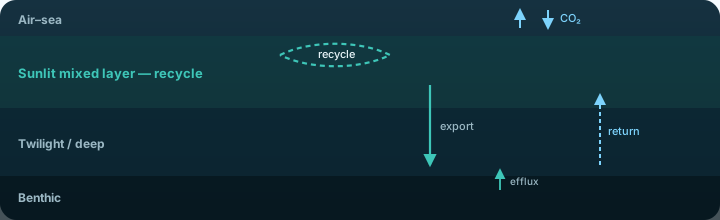
Program framing at a glance
- Ecology first. Restore the biogenic nutrient fluxes marine life once provided. Assumption (founder statement)
- Three levers. Iron bioavailability, multi-nutrient stoichiometry and food-web recycling. Assumption (founder statement)
- Carbon second. Carbon outcomes are measured, and no carbon claim is made until export and fate are published in peer-reviewed form. Assumption (founder statement)
- Independent of GOOS and Global ONCE. GOOS coordinates global ocean observing through Essential Ocean Variables Source: Martín Míguez et al. (2026); Global ONCE is a negative-emissions science-to-governance program Source: Global ONCE Program (2025). Ocean Flux uses both only as external context.
- Working hypothesis. Fishing, whaling and simplified food webs impaired regenerative nutrient cycling; the sources differ on how much. Assumption
Read the full program framing →
Source: Author et al. (Year) = source checked; the tag opens it. Assumption = founder statement or working hypothesis. Unknown = no source yet.
Explore the work
Pelagic fluxes
Which organism groups move C, N, O, H, P, S, Si, Ca, Fe and trace metals, with a source for every value.
Program framing
Scope, positioning, and how Ocean Flux sits beside GOOS and Global ONCE, with references.
Biology
Phytoplankton guilds, iron enzymes, macroalgae, seagrass, grazers and fishes.
Chemistry
Carbon pumps, nitrogen, iron bioavailability, P, Si and trace metals.
Flux Explorer
Teaching models of ocean carbon and nutrient fluxes.
Founder
Neil Beckwith — environmental chemist and biogeochemist; founder of Ocean Flux (Ontario, Canada). Contact [email protected].
Start a conversation
Science collaborators and readers — reach us directly.
[email protected] Email for overview deck